
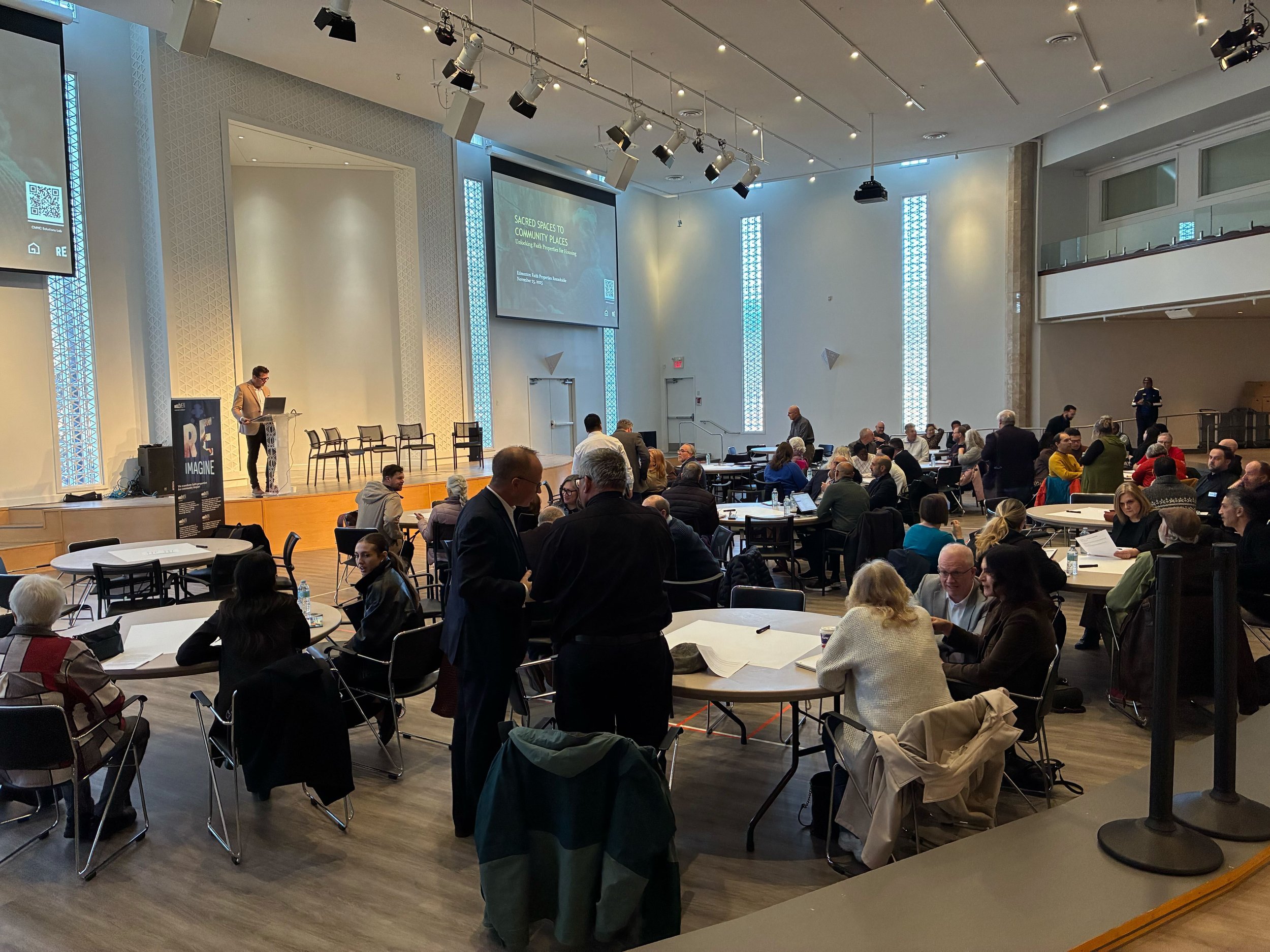
The Edmonton Faith Properties Roundtable was held at West Edmonton Jamakthana on November 25, 2025, from 1:00–5:00 p.m., followed by a catered networking reception. The event was hosted by Relèven and Affordable360, and sponsored by CMHC (through the Solutions Lab program) and the City of Edmonton.
Welcome, Land Acknowledgement & Context
The program opened with official greetings from Christel Kjenner, Director, Housing Action Team, City of Edmonton, who brought the City’s support and framing for the conversation.
A land acknowledgement situated the gathering on Treaty 6 Territory, recognizing the Cree, Blackfoot, Métis, Nakota Sioux, Iroquois, Dene, Inuit and many others, and explicitly connecting the work on faith lands to Indigenous traditions of generosity, reciprocity, and stewardship of land as a sacred trust.
Relèven and Affordable360 then set the context:
Canada is facing two converging crises—widespread closure risk among religious properties and a severe affordable housing shortage.
The National Trust estimates up to one-third of congregations may close this decade, with billions in land value and more than $18 billion in annual social impact at risk.
Faith communities are Canada’s second-largest landholder, creating a major opportunity to repurpose underused sites for housing, community services, and Indigenous justice.
Methodology, Data & Case Studies
The organizers outlined the CMHC Solutions Lab approach and the Faith Properties Solutions Lab methodology:
Integrating CRA charity data, municipal data, zoning, transit access, and geospatial analysis to identify faith sites with strong redevelopment potential.
Using a multi-criteria, data-driven screening process to rank sites and then produce 3D massing concepts and early cost estimates in partnership with Affordable360’s pre-development tools (MapYourProperty, Giraffe, Aprao).
Combining analytics + community/municipal engagement to prioritize properties that are both technically viable and aligned with local needs.
They shared Edmonton-specific findings:
744 faith charities / 476 confirmed religious properties identified in the city.
Roughly 30% of organizations are in financial deficit; about 140 sites show signs of financial distress.
About 60% of faith properties already have some form of residential zoning; building on only 20% of faith lands in Edmonton could yield an estimated 3,500 new affordable units, housing up to 5,000 people.
Six illustrative case studies then showed how specific Edmonton sites (e.g., McDougall United Church and several neighbourhood congregations) could accommodate low-rise and mid-rise housing while maintaining community space, with project concepts ranging from 24 to 250 units per site.
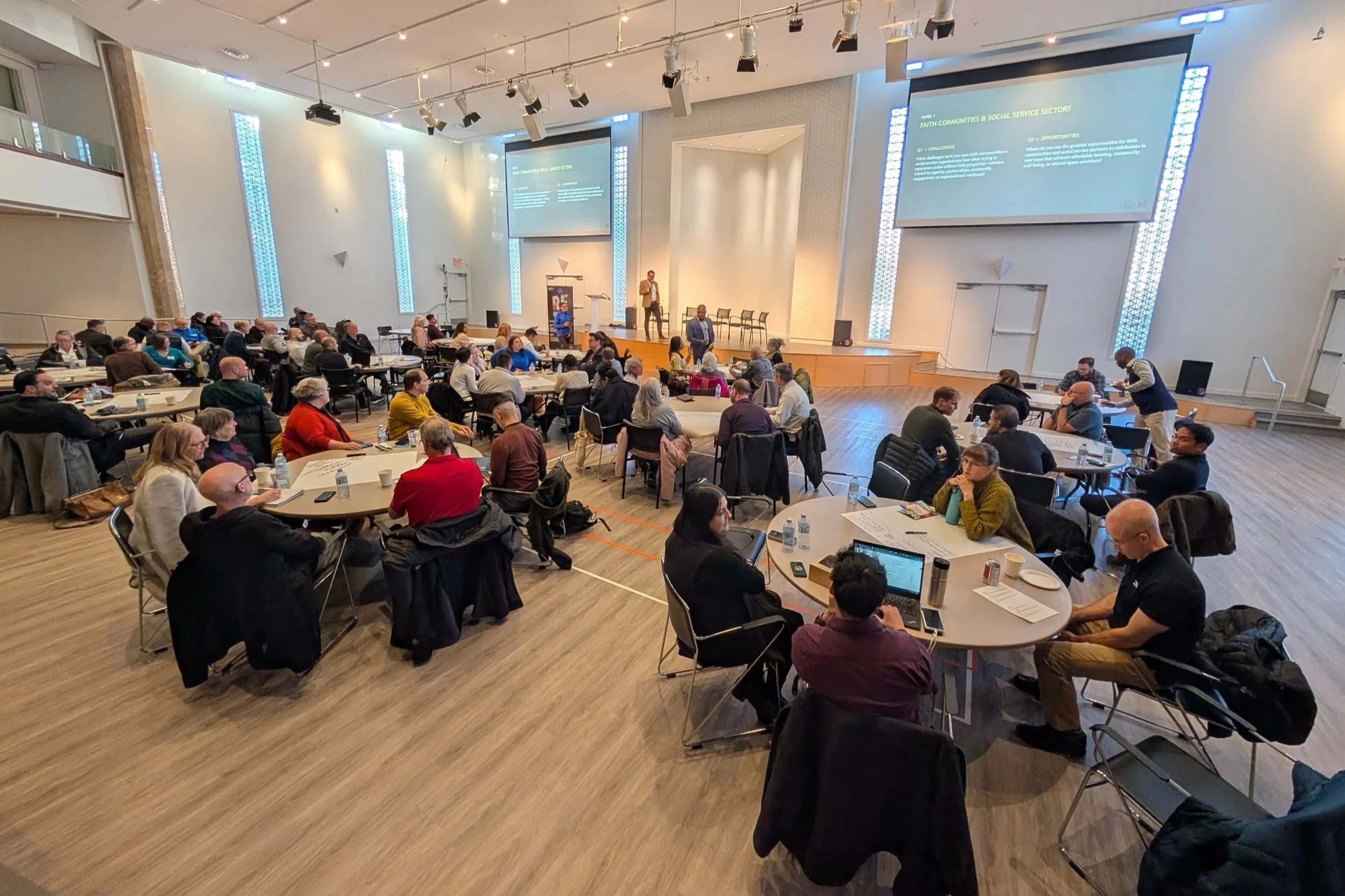
Panel 1 – Sacred Spaces to Community Places
Focus: Unlocking the Potential of Faith Properties – how faith communities and social-service partners can repurpose underused religious lands and buildings for housing and community benefit.
Moderator:
Dave Harder, Director of Placemaking, Relèven
Panelists:
Rev. Annabelle Wallace – Minister, Presbyterian Church in Canada
Omar Yaqub – Executive Director, IslamicFamily
Marissa Redmond – Executive Director, Right at Home Housing Society
Shaun Loney – Member, Property Redevelopment Team, St. Mary’s Road United Church (Winnipeg)
This panel explored:
The emotional and spiritual significance of sacred spaces in neighbourhoods.
Barriers faith groups face—capacity, partnerships, and community resistance.
Opportunities for shared spaces and social-purpose co-location (housing plus food programs, childcare, etc.).
Panel 2 – Funding the Future
Focus: Investing in Housing Opportunities on Faith Properties – financing, investment models, and risk-sharing structures to move projects from idea to pre-development and construction.
Moderator:
Christopher Trotman – Relèven, Fund Portfolio Manager
Panelists:
Jacqueline Alderton – Director of Policy and Research, ASCHA
Rionel Comia – Manager, Project Development and Affordable Housing & Homelessness, City of Edmonton
Ryan Young – Executive Director, Social Enterprise Fund, Edmonton Community Foundation
Sandie Price – Innovation and Partnerships, CMHC
This panel discussed:
Key financial barriers: pre-development costs, risk tolerance, and fragmented funding.
The role of municipal grants, CMHC programs, community foundations, and social finance in de-risking projects.
Innovative tools such as revolving funds, community bonds, and blended finance structures to unlock faith-owned land.
Panel 3 – From Steeples to Streetscapes
Focus: Navigating Opportunities and Obstacles in Faith Property Redevelopment – heritage, planning, design, and development pathways to move projects through approvals while respecting character and community.
Moderator:
Cory De Villiers – Managing Director, Relèven Realty
Panelists:
Lyla Peters – Director, Development Approvals and Inspections, City of Edmonton
Edward Archibald – CEO, A Good Life Group
Tai Ziola – Partner and Architect, Dialog
Laurence East – Growth Strategist, Reframe Concepts
Themes included:
Planning and zoning hurdles, especially in older or heritage buildings.
Balancing heritage conservation with density and modern building codes.
The importance of early, transparent collaboration among congregations, city staff, and development teams to maintain trust and manage expectations.
Charting a Path Forward & Reception
The event closed with a “Charting a Path Forward” segment summarizing key learnings:
Use faith-literate facilitation and put mission before market.
Engage municipalities early to clarify feasibility.
Combine data and storytelling to build support.
Name tensions around survival vs. community benefit up front.
Participants were then invited to a catered networking reception, creating space for continued conversation among faith leaders, housing providers, planners, funders, and community partners, reinforcing that “it’s all about partnerships.”